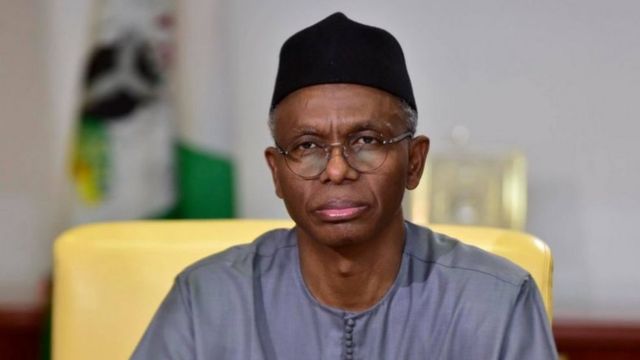
The Independent Corrupt Practices and Other Related Offences Commission (ICPC) has disclosed documents, electronic devices, and other items allegedly recovered from the Abuja residence of former Kaduna State Governor, Nasir El-Rufai.
ICPC made the disclosure in its filings submitted at the FCT High Court in Abuja to counter a N1 billion fundalmental rights enforcement suit filed against it and others by El-Rufai.
The former governor had filed the suit against the ICPC, the Economic and Financial Crimes Commission (EFCC), the Department Security Service (DSS), and the Attorney-General of the Federation (AGF) over his alleged illegal arrest, detention and search conducted at his home in Abuja last month.
He described the investigations as politically motivated and said he would respond to the allegations in court.
According to PREMIUM TIMES, ICPC urged the court in its filing to dismiss the suit, citing its discoveries during its agents’ search of El-Rufai’s house at 12 Mambilla Street, Asokoro, Abuja.
ICPC said the search was conducted from 1:37 p.m. to 3:56 p.m. on February 19 based on a magistrate-issued warrant dated February 18.
The agency said its officials were accompanied by personnel from the Nigeria Police Force, adding that the search was witnessed by El-Rufai’s wife, Hadiza, and his son, Mohammed.
ICPC said it recovered investor account statements and asset declaration forms belonging to El-Rufai.
ICPC also said it seized certificates of registration for business entities, including Millennium and Harmonised X Ltd, alongside corporate compliance records and client KYC files.
The anti-graft agency also claimed to confiscate the African Democratic Congress (ADC) welfare secretary documents dated November 29 2025, records of domestic and foreign loans approved by the Kaduna State House of Assembly between 2015 and 2023, and interim investigation reports involving El-Rufai and his associates.
Other documents obtained include Ecobank Nigeria PLC share certificates dated October 3, 2008, and land files and student financial services documents.
The ICPC said it recovered nine flash drives, one memory card, and seven hard drives.
The anti-graft agents also seized multiple laptops, including Apple MacBook Pro and Elumac Book Pro models, as well as mobile phones comprising Blackberry, Nokia N95, Toshiba, Samsung IDEOS, Google IDEOS, and 18 other devices.
The agency retrieved a Remarkable tablet and its chargers, along with folders containing flight tickets stored across various devices.
All devices were properly documented and sealed for forensic analysis.
ICPC also said its agents recovered valuation reports and deeds of assignment for properties located at plots 18071, 13071, and 14 Kano Road.
The team also seized irrevocable Powers of Attorney covering multiple properties, consolidating ownership and transfer records for investigative purposes.
In addition, it claimed the agents secured Afri-Venture Capital Company documents, including bank statements, cheque books, and corporate records.
It also claimed they confiscated payment mandates and media/publicity documents from the Office of the ex-governor, materials related to the 1st Saudi-Africa Summit, Nigerian Pilgrims Platform management, and plans for proposed residential developments in Abuja.
Additionally, it said petitions and invitations involving the Royal Embassy of Saudi Arabia and the INC 20th Anniversary Colloquium were recovered.
A detailed Device Documentation Form was completed for all electronic devices, recording serial numbers, types, storage details, and accessories.
The recovery operation was witnessed and confirmed by Hadiza El-Rufai, Mohammed El-Rufai, Ajibade Abiodun, and Asjuquo J.E on February 19.
However, El-Rufai’s remark in the document stated that he did not grant consent for any access to the devices listed or found in his house.
The ICPC stated that the recovered materials will undergo forensic analysis as part of ongoing investigations into alleged corruption and asset concealment.
Reacting to the allegations in a statement on Monday, El-Rufai’s family accused the anti-graft agency of attempting to criminalise El-Rufai’s decision to remain silent during interrogation.
Quoting the former governor Nasir El-Rufai, the statement signed by El-Rufai’s son Bello, who is a serving member of the House of Representatives, stated, “CHARGE ME, IF YOU HAVE ANYTHING AGAINST ME. YOU HAVE HAD MORE THAN 2 YEARS TO INVESTIGATE ME. TAKE ME TO COURT PLEASE.”
The family maintained that his silence in custody was an exercise of his constitutional right and not evidence of guilt, stressing:
“The Constitution of the Federal Republic of Nigeria guarantees every citizen the right to remain silent.”
They further argued that drawing negative inferences from that silence reflects what they called an “inquisitorial mindset” on the part of the ICPC.
The family countered that only personal effects were taken from the searched home.
“WE WERE PRESENT WHEN THESE ITEMS WERE SEIZED. No equipment other than old discarded personal mobile phones… storage devices like flash drives and laptops… were seized from the property,” the younger El-Rufai said.
According to them, the alleged “sophisticated tapping equipment” exists only “in the fevered imagination of the ICPC and its press team.”
A major plank of the family’s response is the claim that the search itself was based on an invalid warrant.
Their statement alleged that the warrant was fraudulently procured and signed by a magistrate “purporting to sit in the High Court of the Federal Capital Territory,” describing the entire process as legally defective.
“Our lawyers have challenged this illegitimate warrant in a court of competent jurisdiction,” the statement added, inviting the ICPC to justify the document in court.
The family further accused the Commission of engaging in “forgery, uttering of false documents, and peddling of falsehood.”