By Sola Ajisafe.
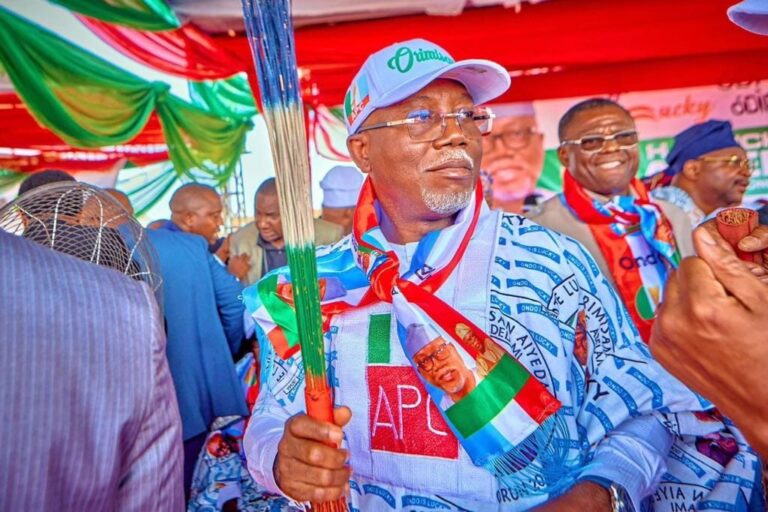
The recent attempts to frame the Governor of Ondo State as the man who “owns the game” and as a symbol of “political maturity” cannot stand a factual examination. The central exhibit being used is the Idanre rally. That event was not convened by the Governor’s office, was not funded by the State apparatus, and was not coordinated with the State Party Chairman. Yet the Governor appeared unannounced and uninvited to address the gathering and speak on “unity” and “reconciliation.” This is being sold as confidence. In reality, it is either intrusion or co-option.
I am of the view and can be corrected if I’m wrong that leadership is demonstrated by initiative, by building, by funding, and by command. What we saw in Idanre was intrusion. A principal who truly controls a party structure does not need to insert himself into a program he did not build in order to prove relevance. The very act of gatecrashing by the governor as witnessed in Idanre concedes that control is being contested.
The argument that “leadership is tested in disagreement” is correct. But the test must also be applied to how this administration has handled disagreement. The record shows a consistent pattern of strife, violence and lack of inclusion. Also, it is signposted by externalising responsibility. It is on record that for every failure in mobilization, for every fracture within the party, for every administrative shortfall, the explanation offered is the same of Dr. Olubunmi Tunji-Ojo. That is not engagement. That is scapegoating.
A leader who claims to want a united party does not spend his political capital blaming a single member of his own party for every problem. He builds bridges and he carries the burden of results. The repeated deflection is not strategy. It is evidence of an inability to reconcile the demands of office with the capacity to deliver. It is said that leadership entails responsibility. The President of our nation has aptly displayed the culture of accepting responsibility for every negative impact of his current reforms in Nigeria. Our governor should learn that protocol.
On results, both narratives are silent, and that silence is instructive. The Governor was appointed Campaign Director-General for the Presidential election and publicly committed to delivering 1 million votes from Ondo State. The State returned less than 370,000 in the last governorship election in the State. That is a deficit of over 630,000 votes. Now, with the party more fractured than it was during that election, and with no new structure built to close that gap, the same administration is asking the public to believe it can deliver far more than it delivered when it was most invested. The question is direct and cogent, how does one promise to achieve what one could not achieve in one’s own election, at a time when the party was less divided and resources were fully deployed?
An intrusive presence at a rally does not answer that question. “Showing up” is not a metric. Votes are. Political ownership is not proven by press releases. It is proven by performance. Performance is actual and verifiable.
Again, there is also the question of coherence. The public message is unity and one party family. Yet, the political practice is different. At the same time that unity is being preached in Idanre, the Governor’s proxies are engaged separately with DLA structures in the North, ADC elements in the Central, and PDP actors in the South. Meanwhile, the so-called Reconciliation Committee has produced no tangible outcome. A committee that does not reconcile is not a committee. It is a public relations posture. You cannot call for a single house while allowing different rooms to be rented to different tenants. That is not accommodation. That is fragmentation. I also ask, where is the GAC? Where is the Elders council of the governor in all this? Where are the Mabaja enablers running around the corridors of power in Abuja and Bourdilon? Where is the State Working Committee and the state Executive Councli in this scenario. Who is the Elder or person in Ondo State among the people around Mabaja to tell him he is not doing too well in his leadership profile? Who is that Jephta or Jeremiah in Israel? Who?
Finally, let us be fair, as the other article asks. The Presidency receives daily political and security briefings from all 36 states. The party leadership tracks funding, mobilization, and stakeholder engagement. By all available indices known in Abuja and within the party structure in Ondo State, the one consistent factor that has kept the APC from total collapse in the State is the direct, resource-backed engagement of the Minister of Interior, Dr. Olubunmi Tunji-Ojo. It is his work in mobilization, in funding critical party activities, and in sustained outreach to stakeholders across the three senatorial districts that is reflected in the reports reaching the center. While there has been much noise from the Governor’s camp about ownership, it is the Minister’s quiet, deliberate work that resonates most with the leadership in Abuja. In a period of division, he has remained the connecting rod. That is not speculation. That is data.
What was plainly before us in Idanre was not the emergence of a leader who owns the game. It was the appearance of a principal who needed to be seen in a game he did not build. To own the game is to set the agenda, fund the structure, deliver the votes, and carry the responsibility. What we have observed is gatecrashing, grandstanding, political arrogance and fillibustering, missed targets, scapegoating, and contradictions. That is not ownership. That is tenancy.
Oloroogun Sola Ajisafe writes from Ode Olukoro, Oraa Ikanmu, Oka-Akoko
About the Author