
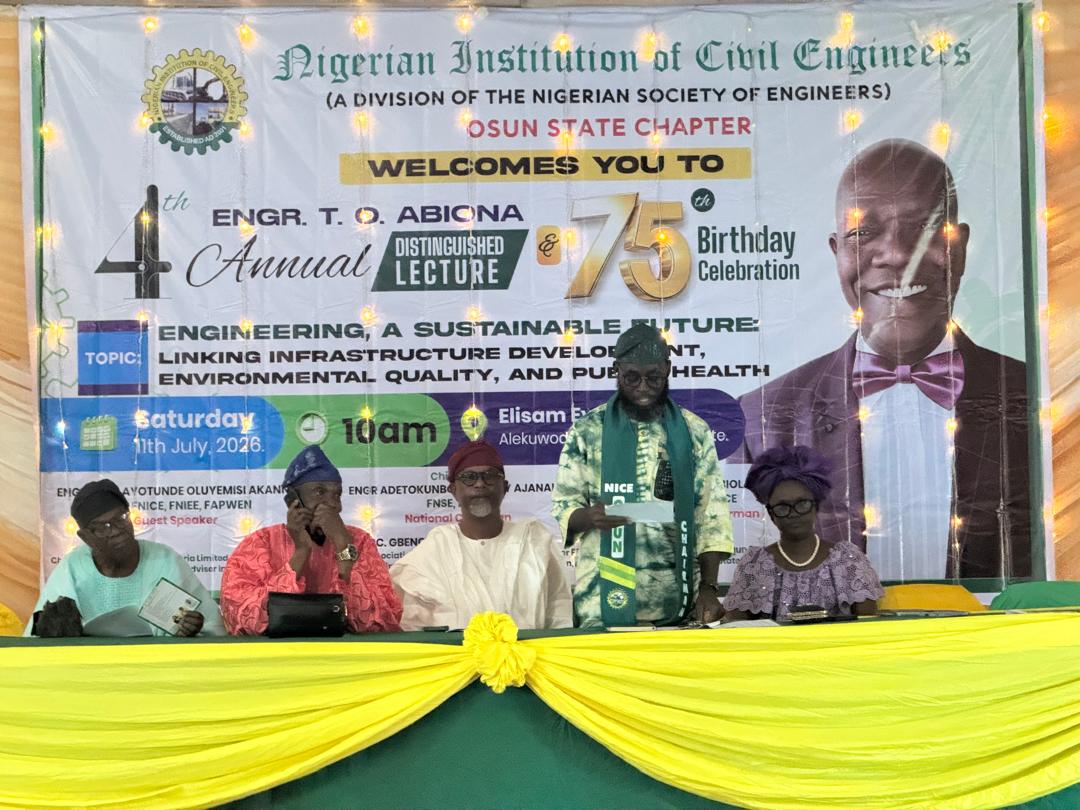
The Nigerian Institution of Civil Engineers (NICE), Osun Chapter, has expressed concern over the adverse effects of environmental risks on the well-being of Nigerians.
The institution raised the concern at its 4th “Engr. Timothy Abiona Annual Distinguished Lecture” held on Saturday in Osogbo.
The lecture was themed: “Engineering a Sustainable Future: Linking Infrastructure Development, Environmental Quality and Public Health.”
The guest lecturer, Engr. (Mrs) Ayotunde Akanni, said that in developing countries, including Nigeria, issues such as flooding caused by inadequate drainage, contaminated water, indiscriminate waste disposal and worsening air pollution were not isolated environmental problems.
Akanni, Dean, Faculty of Engineering and Technology, Federal Polytechnic, Ile-Oluji, Ondo State, described the challenges as engineering issues with far-reaching implications for public health and economic development.
Citing data from the World Health Organisation (WHO), she said that about 13 million premature deaths occur globally each year due to environmental risk factors linked to infrastructure decisions.
She added that air pollution alone accounts for about seven million deaths annually, making it one of the leading environmental threats to human health.
According to her, many environmental risks are directly tied to how infrastructure is planned, designed, constructed and maintained, with significant human consequences.
On the link between infrastructure, environmental quality and public health, Akanni noted that fossil fuel-based transport and energy systems remain major contributors to air pollution, leading to increased cases of respiratory diseases, cardiovascular conditions and lung cancer.
“Heavy traffic congestion and widespread use of petrol and diesel generators expose millions of Nigerians to daily emissions. Poor air quality is no longer occasional but a constant reality,” she said.
Akanni also observed that while heavy rainfall should replenish natural resources, it often results in devastating floods where drainage systems are poorly designed, inadequately maintained or entirely absent.
She said floodwaters contaminate drinking sources, damage sanitation facilities and spread waterborne diseases such as cholera and typhoid fever.
“Flooding in Lagos has shown how planning failures, inadequate drainage and climate change can combine to create disasters.
“In many cases, flooding is not purely a natural occurrence but the result of preventable engineering and planning failures,” she said.
Akanni, however, identified sustainable engineering solutions such as renewable energy systems, green and resilient urban infrastructure, circular systems and nature-based solutions as critical to mitigating environmental risks.
She urged government and policymakers to prioritise sustainable infrastructure, adopt integrated planning approaches and invest consistently in capacity development.
In his welcome address, the Chairman of NICE in the state, Basiru Saliu, described the lecture theme as timely and significant.
“Across the world, engineers are increasingly called upon to provide innovative solutions that not only address infrastructure deficits but also promote environmental sustainability and safeguard public health.
“Sustainable development is no longer optional; it is imperative,” he said.
Saliu said civil engineers have a responsibility to design, construct and maintain infrastructure that enhances quality of life while preserving the environment for future generations.
He also commended Abiona, a former chairman of the institution, for his integrity, discipline and dedication to service.
“His remarkable career exemplifies professional competence, visionary leadership and unwavering commitment,” he said.
About the Author