
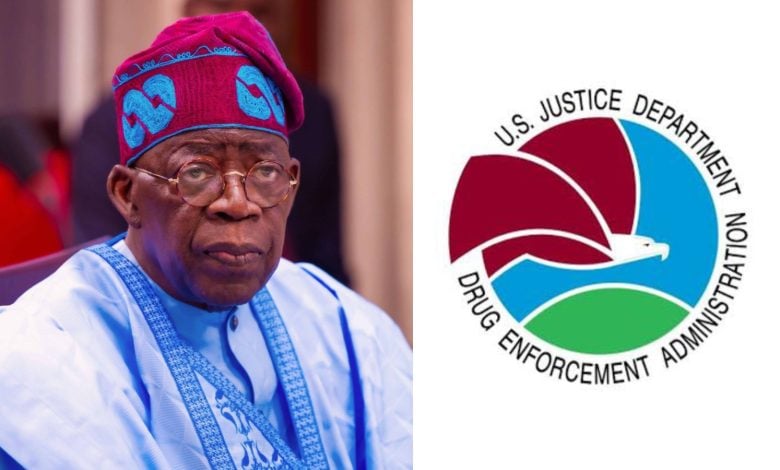
The United States Drug Enforcement Administration (DEA) has explained why it is withholding from public access, portions of its investigative records involving President Bola Tinubu.
The agency stated that the withheld portions contain information that could expose confidential sources, reveal non-public investigative methods and provide other sensitive details connected to law-enforcement activities.
The explanation was contained in the Wednesday, September 23, 2026 court filing by the United States government in an ongoing Freedom of Information Act (FOIA) case before the United States District Court for the District of Columbia.
The case was filed by American transparency activist Aaron Greenspan, who is seeking the release of historical records held by US federal agencies concerning investigations involving Tinubu and other individuals.
The case, Aaron Greenspan v. Executive Office for U.S. Attorneys et al., is a civil FOIA dispute over access to government records.
The latest filing was made as the US government defended the DEA’s decision to redact or withhold parts of the records sought by Greenspan.
The filing specifically refers to a declaration submitted by the DEA, identified as the Davis Declaration, as well as an accompanying Vaughn Index explaining the basis for the agency’s withholding of information.
The plaintiff had challenged the DEA’s Vaughn Index, arguing that it contained similar justification paragraphs and entries.
The government, while rejecting the criticism, explained that the DEA records consisted of similar types of investigative documents, including DEA-6 Reports, DEA-292 Reports and DEA-210 Reports.
The government stated that because the records were similar investigative forms and types of investigative records, the justification for withholding information from them would naturally involve similar reasoning and exemptions.
The filing therefore confirms that the records at issue include formal DEA investigative reports connected to the criminal investigation.
One of the significant portions of the government’s filing concerns information was confidential sources.
The government said the DEA had fully addressed the potential harm that could result from disclosure of such information in its declaration.
Quoting the DEA’s Davis Declaration, the filing states: “Any information related to confidential sources ‘could reasonably be expected to disclose the identity of a confidential source.’”
The DEA further stated that information relating to confidential sources “has long been afforded the most comprehensive protection of all the FOIA exemptions.”
The agency then explained why it considered the information sufficiently sensitive to remain withheld.
“Due to the significant protections afforded to prevent the disclosure of this type of information, DEA determined that the significance of exempting this type of information outweighed the relatively insignificant public interest in the disclosure of the information,” it stated.
The DEA’s position is therefore that releasing the information could expose the identities of people who provided information to law enforcement, while the agency considers the protection of those sources to outweigh the public interest in disclosure.
The government also defended the use of FOIA Exemption 7(E) to withhold non-public details of investigative techniques.
The filing says the plaintiff conceded that the FBI could withhold “non-public details of investigative techniques,” but sought an order compelling the government to produce a redacted ex parte declaration filed under seal.
The government argued that this did not undermine its reliance on Exemption 7(E), particularly because the records arose in the context of “a criminal investigation of a drug operation.”
The argument indicates that, beyond information that could identify confidential sources, some of the withheld material could reveal how law-enforcement authorities conducted or documented their investigation.
The September 23 filing is largely focused on the government’s legal justification for withholding information.
However, the broader court record establishes the connection between the FOIA litigation and Tinubu.
In an April 2025 ruling in the same case, U.S. District Judge Beryl Howell addressed FOIA requests seeking criminal investigative records concerning Tinubu and Abiodun Agbele in connection with a federal investigation into an international drug-trafficking and money-laundering operation.
The earlier proceedings concerned requests for records from the FBI and DEA relating to a Nigerian heroin-distribution organisation that was active from approximately 1988 to 1994 or later.
The court record identified “Tinubu, Bola Ahmed” among the individuals referenced in the relevant request.
Judge Howell’s 2025 ruling also dealt with an earlier attempt by the agencies to issue what is known as a Glomar response, under which an agency refuses to confirm or deny whether responsive records exist.
The judge concluded that the government could not rely on that approach in the circumstances of the case because the existence of the investigation had already been officially acknowledged.
However, the September 23 filing does not disclose the substantive contents of the DEA records concerning Tinubu.
It does not state how many records mention him, what confidential sources told investigators, whether any source made allegations against him, or whether the DEA found evidence of criminal wrongdoing by Tinubu.
It also does not disclose what transactions investigators identified or whether the withheld records contain evidence establishing any criminal conduct by him.
What the filing establishes is that the DEA has investigative records within the scope of the FOIA litigation and is defending its decision to withhold portions of those records under specific FOIA exemptions.
About the Author